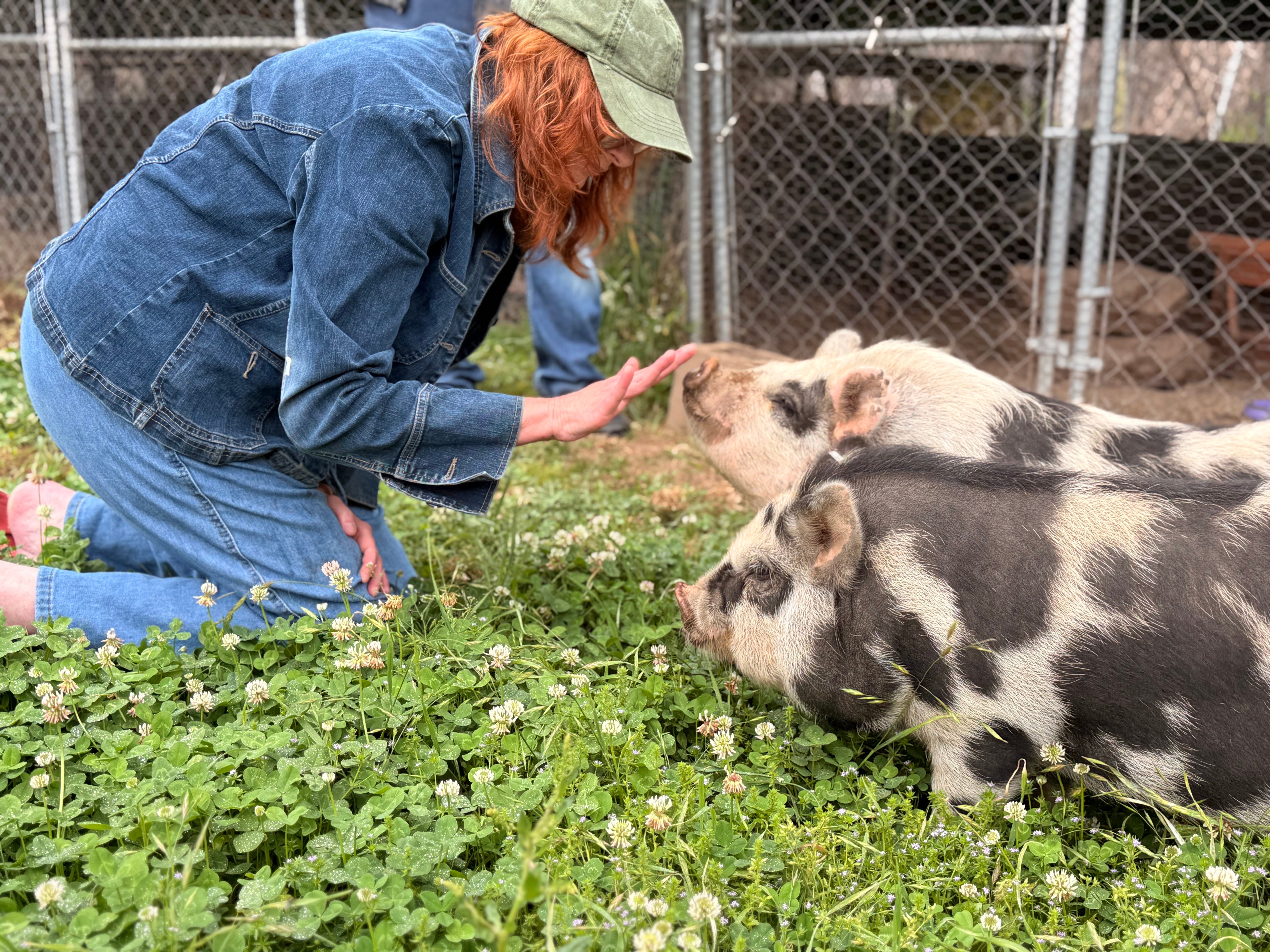
To those who did not grow up in the rural pockets of Monroe County, Missouri, the culture we inherited would look almost primitive—a jarringly backward system of transactional survival masked by religious piety. But to a child raised in it, the isolation was absolute, and the rules of the terrain seemed as fixed and permanent as the horizon. I couldn’t imagine a childhood stuck indoors playing video games. My world was filled with baby animals to find, moss to lay on, trees to climb, and imaginary castles, swords, and magic places hidden in the timber.
The woods around Granville were beautiful to me, a place where there was always an adventure to be had. But even my childhood sanctuary was stained by the utilitarian culture of the adults around me. Every year—sometimes several times a year—the creek would flood the sharp, 90-degree corner of the blacktop on Route J that ran right through Granville. This flooding would add at least 40 minutes to the school bus ride, forcing us to detour through miles of long, winding gravel roads.
As a kid, I played in that creek constantly, never once thinking about what might be lurking in the water. To the local farmers, the creek wasn’t a sacred piece of nature; it was a drainage ditch. They routinely dumped dead livestock directly into the water upstream. I would often come home from my magical adventures covered in leeches, entirely unaware of the rot flowing through my playground.
To understand how this world degraded by the time my parents were young, one must look at how it was seeded. My grandparents’ families came to Granville as part of a massive 19th-century migration from the Upper South—primarily Virginia, Maryland, and Kentucky. Traveling westward along the Ohio, Mississippi, and Missouri river systems, they brought a very specific social blueprint with them.
This region of Northeast Missouri became known historically as “Little Dixie” because the settlers meticulously reconstructed the plantation-style, feudal hierarchies of the old South in the fertile timberlands and river valleys of the Salt River. They built a world of deep insularity. When they settled near Otter Creek, they didn’t just clear the forest; they established a rigid social caste.
The Mind of Metal and Wheels
J.R.R. Tolkien wrote profoundly about the “Mind of Metal and Wheels.” It is the spirit of Saruman—a cold, mechanical, administrative worldview that looks at a tree and sees only timber, looks at a family and sees only utility, and looks at a creek and sees only a place to dump waste.
Tolkien saw this exact transition play out in his own childhood. He grew up in Sarehole, a rural English hamlet filled with rolling hills, a peaceful watermill, and ancient woods that became the direct blueprint for his fictional Shire. But as the late 19th century progressed, the industrial mega-city of Birmingham rapidly expanded outward. The smoke, the asphalt, and the cold machinery of progress swallowed Sarehole. Independent village life was dismantled by corporate managers, and the countryside was cut up into industrial grids. Tolkien spent his entire life grieving this loss, writing The Lord of the Rings as a mythic protest against the machine’s destruction of the organic human soul.
When my grandparents were young, Granville still possessed a version of that organic, Shire-like vibrancy. Survival required community. Families butchered livestock together, organized shared silage crews, and helped one another bring in the harvest. There were always personality clashes, feuds, and bitter gossip, but they cooperated because they had to. Our nearest neighbors were five miles away, yet we knew more about their daily lives than I have ever known about a neighbor living in an apartment right next door to me in a city.
But by the time I came along, the federal government was shifting the rules, making it impossible for small, traditional farmers to make a living. The message from Washington was clear: get big or get out. Those who held onto their long-held beliefs, heritage, and modest traditions slowly found themselves fading into bankruptcy. A few aggressive farmers survived by absorbing the rest—buying out or leasing neighboring farms to scale up into massive operations.
They grew, but it killed the community. The transactional machine replaced the human network. That vital, ancestral cooperation had largely evaporated by the late 1970s. I am old enough to remember our community butchering together exactly once. After that, the silage crews vanished, the small farms were swallowed, and the countryside became a quiet, lonely grid of corporate agriculture.
The loss of local autonomy followed the economic collapse. The community was fractured when local children were stripped of their neighborhood schools and forced by bureaucratic decree to attend high school in Paris rather than Shelbina. It wasn’t a mere boundary dispute; it was a corporate flattening of community identity. Soon after came the ultimate physical manifestation of the machine: the flooding of the valley to create Mark Twain Lake. The modern world literally drowned our history, burying old homesteads and the ancient heritage of the land—including the indigenous burial grounds near Santa Fe—beneath millions of gallons of water to create a sanitized tourist attraction.
Excerpt from The Sovereign Seed
As the years crawled on, the skin of the family’s dirt empires began to peel back, revealing the broken, jagged bones beneath the surface. The men of her childhood were scarred figures masquerading as farmers. Her father’s father was a terrifying presence. For the longest time, she thought he carried a small, permanent pillow on his hand. It wasn’t a pillow; it was a mass of stolen flesh—a skin graft from another part of his body from the afternoon a massive combine harvester caught his arm and tried to chew him to pieces. He was half-blind, too, missing an eye from the day he ran his tractor straight into the brutal spikes of a thorn tree.
Her father was the oldest of three brothers born to this scarred figure. The middle brother had just returned home from the army, carrying the quiet weight of the military, but it was the youngest brother who captured her imagination. He was seventeen, born with a severe heart condition when her paternal grandmother was forty-eight, and he still lived at home. A long, protruding red scar ran like a jagged boundary line from his neck all the way down to his belly. He thought the girl was a bother, but she thought he was the height of cool. He kept music in his bedroom that no one else in their strict world listened to. When he wasn’t home, she would sneak past his threshold into the quiet, just to sit in the dark and listen to the cassette tape of Toto’s Africa, letting the synthesized rain wash over her while the farm sweltered outside.
Her paternal grandparents lived in a very simple house at the end of a long, dusty dirt lane. The passage into their domain was guarded by a broken concrete bridge; to get to them, you had to cross it. It was a place where life and death met casually in the gravel; she remembered the afternoon the entire family walked down the lane just to stare at the carcass of a dead badger someone had struck on that fractured bridge. The house itself was white, shaded by a giant, sprawling tree that dropped heavy shadows over the porch swing. The yard was a graveyard of old cars and rust-streaked tractors, and their water came straight from a deep well. Inside, the house wore the grime of the fields. The kitchen, the carpet, and the bathtub were always dirty, and she hated using their forks because she never knew if the metal would be truly clean.
Her grandmother was a volatile, walking contradiction—funny, creative, and loud. She hosted a club she called the Tuesday Girls, a weekly gathering where old farm ladies would escape their houses, sit in her dining room, and paint pictures until the entire house smelled of turpentine and oil. But she was also prone to sudden, piercing screams that could slice through the heavy August air. The girl was always searching the property for wild things, and the voice could often be heard shrieking across the yard, ordering her to “put that raccoon down or I’m gonna call your daddy.”
Her mother’s side of the family was fancier, but their blood ran colder. Her grandfather on that side was a ruthless negotiator, an old-school barter-king who ground people into the dirt for a dollar. Yet, the world outside saw a different man. People loved him; he was jolly, charismatic, and always had a funny, sharp quip ready for everyone he met. Behind his public charm, the family laws were strict, unspoken, and cruel. The tribal boundary was absolute regarding who could marry into the lineage. The only Black person she ever saw was a lone kid in high school who played the drums in the band—a boy who literally lived on the other side of the train tracks, marking the psychological edge of a segregated world.
Her grandparents always drove newer cars, operated newer tractors, and possessed a massive, gleaming machine shed where every tool and piece of equipment was kept neatly ordered. Because there were no sons to carry his name or labor in his fields, they maintained a second, smaller house way back in the field where their hired hand lived.
There was an underlying tension running through the women, too, buried underneath layers of domestic perfection. Granny had been a very pretty girl who loved to go to dances, and she kept her house meticulously clean. Every single night, she stood at the stove and made dinner—chicken fried chicken, or steak, or some other fried meat glistening with gravy. Always gravy. The girl thought she was the best cook in the entire world.
But Granny also carried a darker, heavier shadow. Sometimes the blinds would stay shut, and she would sleep all day, retreating into a quiet oblivion. She possessed a razor-sharp tongue and fully expected to get her way in everything. She liked pretty clothes, immaculate things, and a status she could display. A foundational piece of advice she often hammered into her granddaughter was, “You don’t love a man for his money, you love the man with money.”
The Feudal Matrix and the Disposable Appliance
Underneath this changing landscape lived a dark, Southern Gothic paradox. The culture loudly proclaimed Jesus and His teachings on Sundays, but practiced a ruthless agrarian feudalism from Monday to Saturday. In this transactional matrix, a family was not a sanctuary of emotional safety; it was an economic engine. Wives were unpaid domestic managers. Children were a utilitarian labor force.
Land was the ultimate currency of control, and its distribution was vicious. In these old dynasties, inheritance was used as a weapon to enforce conformity. To deviate from the patriarchal ideal—whether through the vulnerability of alcoholism or by being gay—meant total erasure from the family line. Deviancy meant you were cut out of the empire entirely.
This was the environment that shaped my father, the oldest of three boys. He bore the heavy, crushing brunt of this feudal pressure. To escape the physical labor of the farm and avoid the draft for Vietnam, he went to college. He took the structural privileges of the feudal system but rejected its sweat. This created a profound, internalized shame—the classic genesis of malignant narcissism. He became a man who viewed people not as souls, but as objects.
When my maternal grandparents generously gave my parents five acres of land to build a life upon, my father didn’t view it as grace. He viewed it as an entitlement. When my mother got sick, her economic and physical “utility” to him ended. True to the Mind of Metal, he discarded the broken equipment. He divorced her and moved another woman into the very house my mother’s family had provided. Decades later, when that second wife developed Alzheimer’s, the pattern repeated with horrific precision: he divorced her, too, because she had become a burden rather than a benefit.
The Old King in His Iron Tomb
Today, the feudal culture he served is dead, but my father remains trapped in its rotting carcass. He sits entombed in a recliner, funded by inherited wealth he never earned, watching Fox News. The television fills his room with a bitter, electronic hum—a modern, digital oracle that feeds his paranoia and allows him to broadcast harsh, administrative judgments on a world he no longer understands. This is not the sort of legacy I want to leave behind.
The Cave and the Broken Lantern
It is a strange thing to be handed an eviction notice from the matrix and realize it is actually a passport to freedom. The wheel told me that stepping outside of its gears meant starvation and failure.
Walking away from the mind of metal allowed me to see the world for what it actually is: a dark cave filled with broken lanterns.
If you travel just an hour north of Monroe County to the Mark Twain Cave in Hannibal, the tour guides will stop the group at a certain point and turn off the electric lights. They do it so you can experience absolute darkness. There are zero photons hitting your retinas. Your eyes will never adjust, and within minutes, you lose your sense of balance and direction.
A lot of the world right now is sitting in that exact cave. The tragedy of modern life is that most people don’t realize they are in the dark. They look at the blue light of the screens in their hands and genuinely believe the sun is up.
We have been conditioned to look for a loud, scary, Hollywood version of evil. But the real enemy is patient. It doesn’t get tired, and it rarely yells. It doesn’t need to knock over your furniture; it just offers to replace it with a slightly better, air-conditioned cubicle. It is the transactional machine that slowly convinces us to treat human souls like garbage.
It keeps us perpetually distracted with modern bread and circuses. We perform a righteous, public outrage over the monstrous actions of global elites, parsing through the horror of ancient gods like Baal being worshipped in the shadows. Yet, while we point our fingers outward in self-righteous fury, we quietly walk back to our own local altars. We sacrifice our peace, our integrity, our family time, and our children’s innocence to the gods of money and success, just to maintain our rank within the system. We become the very wheel we claim to despise.
Striking the Match
I am not writing this as a Bible scholar or a philosopher. I have made massive, deeply painful mistakes in my life. I am just a girl who finally refused to let a broken, transactional heritage run her soul. Right now, I don’t know what tomorrow looks like or how I am going to pay my bills.
But I know this: when you are in a pitch-black cave, it doesn’t take a massive, blinding stadium light to change reality. If you have been sitting in total darkness for years, even a single, tiny match strike looks like a sunrise.
That is what Jesus is to me. He isn’t a political ruler coming to fix the current power structure of our world; He is the exit code from the entire matrix. He didn’t come to play the rigged games of this world or help us “win” things that don’t matter. He came to show us that this current reality is a secondary, broken shadow of a true reality that exists outside of time. He was, He is, and He always will be.
You don’t have to flee to a cave like a hermit to find peace. Your purpose is right here, operating inside a broken system but refusing to let its machinery turn inside your soul.
If you are sitting in the dark right now, terrified of what happens if you stop participating in a rigged game, please know you are not alone. When I was a girl in Granville, I used to sneak into the quiet of a dark bedroom just to listen to a cassette tape of Toto’s Africa, letting the synthesized rain wash over me while the farm sweltered outside. Even then, in the middle of a ruthless feudal matrix, I was looking for the fragments of light.
Look for those fragments today—a flower in a garden, a moment of unearned grace, a quiet breath of truth. The darkness is heavy, but it has absolutely no defense mechanism against a spark. Stop feeding the machine with your fear. Cross the broken bridge. Strike the match.
Join the Chronicle
If you have ever felt the weight of manufactured shame, or if you are still looking for the divine outside of the rigid boxes you were handed, I invite you to join me on this journey.
Subscribe to receive weekly chapters, essays on 90s spiritual culture, and the art that keeps the sky from falling.